PM and CAM marketing workflows
Your next client is checking your last post. What will they learn?
Your team already explains useful things every day. Build a content workflow that makes that expertise visible to rental owners and association boards, with a sustainable rhythm and people responsible for what you publish.

By Jeff Jenkins, founder of EmpowerFrame
·
Part of our series on marketing and operations automation for property management.
Social Media for Property & HOA Management
How often should a PM or CAM company post?
Start with a rhythm your team can sustain: two or three useful feed posts per week on your primary channels, plus time to answer relevant comments. This is EmpowerFrame's recommended starting experiment, not a platform requirement or a proven optimum for every management firm. An accurate weekly explanation is more useful than daily filler that nobody can review.
For a four-week pilot, assign each post a buyer, a question, a format, a reviewer, and a next step. Review qualified conversations, website visits, saves, and production effort before increasing volume. Count existing campaigns toward the total so new content does not overwhelm the feed or the reviewer.
LinkedIn: test 2–3 posts per week
Use operator explanations, original process diagrams, short videos, and document carousels. This is a practical starting point for reaching management leaders and professional referral partners. Check whether the people you want actually engage there.
Facebook and Instagram: test 2–3 feed posts per week
Adapt a useful idea into a visual explanation, a team perspective, or a captioned short video. Add Stories when you have timely, permissioned material. Avoid turning a company feed into a substitute for resident service channels.
Google Business Profile: test one useful update per week
Tie updates to a real service, useful resource, or local business question. Keep business details accurate. A posting cadence is an operating choice, not a promise of better Maps rankings.
YouTube: begin with two useful videos per month
Build a small library of focused answers and demonstrations. Repurpose a strong explanation into a Short when it stands alone. X and Threads are optional conversational channels; add them when you can participate, not merely syndicate.
Choose channels around the buyer and the job
A rental owner evaluating a management company and an HOA board evaluating a management partner need different evidence. Rental content can explain maintenance authorization, onboarding, reporting, or the management approach. CAM content can explain board-packet preparation, ARC handoffs, vendor coordination, and how managers support board decisions. Do not treat residents, owners, and boards as one audience.
For company acquisition, begin with the channels your buyers and referral partners use, supported by a clear website destination and an accurate Google Business Profile. A private community group has a different purpose, moderation policy, and authority structure. A public company post should not be treated as an official association notice or a substitute for the client's required communication process.
Turn real questions into useful stories
Illustrative rental example: an owner asks why a repair needs authorization. A manager explains the threshold, the handoff, and what information makes a decision possible. After removing private details and checking the policy, that explanation can become an FAQ, a simple diagram, and a short video. The story shows how the company thinks, rather than declaring that it offers excellent service.
Illustrative CAM example: explain what makes an ARC application complete and where it goes next. Show who gathers information and who makes the decision. Avoid implying that management can approve a request when the governing authority belongs elsewhere. These are educational scenarios, not completed EmpowerFrame client projects.
Give readers something they can apply now: one question to ask, one handoff to clarify, or one checklist item. Then invite them to explore the harder work of fitting the process to their company. A useful hook creates curiosity by naming a real tension; it does not hide the answer to a basic question behind a sales call.
What should companies do, and what should they avoid?
Assign an editorial owner and a response owner. Use a small library of approved language, current facts, original visuals, and permissioned team perspectives. Write in the terms your audience uses, explain abbreviations, and make the next action specific. Keep a record of the source and review date so old policy information does not quietly become new advice.
Avoid private-message screenshots, identifiable resident disputes, unapproved faces or property details, invented testimonials, and implied client outcomes. For housing-related advertising, have the responsible professional review copy, imagery, targeting, and applicable requirements. Keep sensitive records out of unapproved AI tools. Route complaints and individual service issues to the appropriate private channel instead of debating the person's circumstances in public.
Do not copy another company's posts, buy engagement, stuff keywords, or let a publishing tool invent facts. Do not let routine automation answer sensitive public complaints without a review path. For association channels, define the purpose, moderation rules, escalation owner, and authority to speak before increasing activity.
What can be automated without losing authenticity?
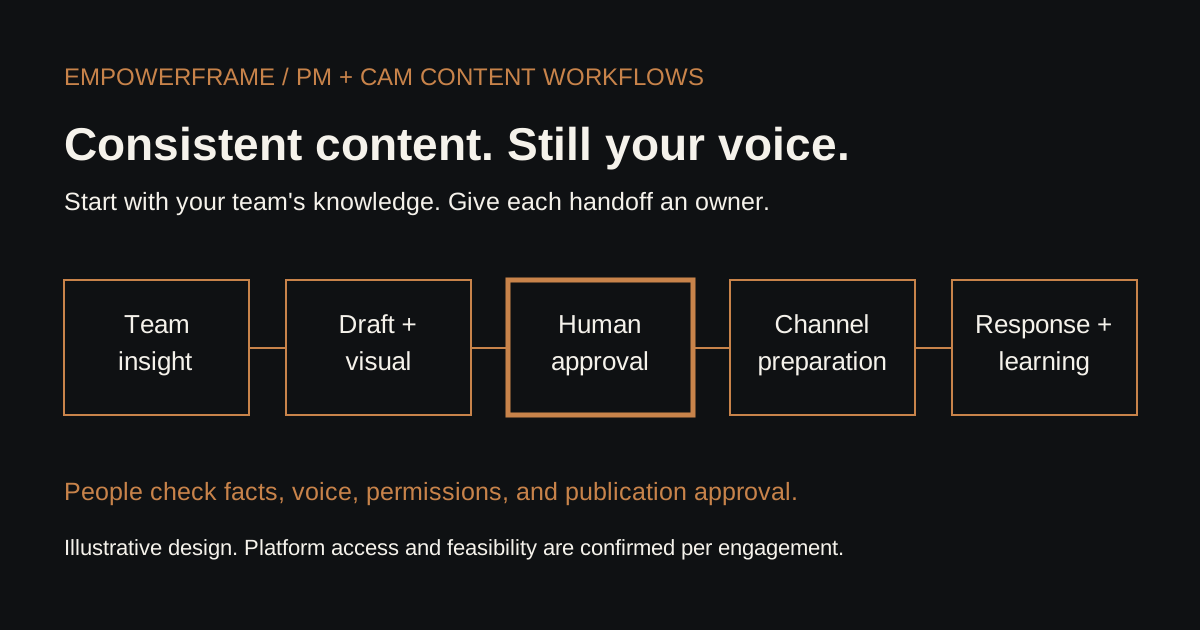
Automation is useful for collecting approved ideas, checking required brief fields, routing drafts, reminding reviewers, preparing channel versions, scheduling approved material, and collecting basic performance signals. AI can help turn a verified explanation into draft captions, outlines, or video text. Neither tool supplies the company's actual judgment or lived experience.
The human checkpoints are facts, permissions, audience fit, company voice, authority, and publication approval. Define what happens when a source is missing, a reviewer is unavailable, a post becomes outdated, or an upload fails. Keep a way to stop scheduled content when circumstances change. The diagram above is an illustrative design, not evidence of a deployed integration.
EmpowerFrame can map that workflow with your team, build a bounded implementation, co-build in your accounts, or teach your people to maintain it. We confirm platform access and feasibility before promising an integration. Your company keeps its accounts, data, documentation, and editorial control. The custom work is aligning the system with your expertise, growth goals, approval roles, and existing tools.
How do search engines and AI find this content?
Give the full explanation a useful home on your website. Use a descriptive title, a direct answer near the beginning, clear headings, crawlable links, and text that explains the information in your visuals. Add accurate alternative text and captions. Identify the author and the actual review date. Make structured data match what a visitor can read.
Google's guidance says established SEO practices remain relevant to its AI search features; special AI markup is not required. Helpful content and technical eligibility do not ensure crawling, indexing, ranking, or an AI citation. Social posts can introduce the story and point to the deeper resource, while the website gives readers a stable destination. Do not promise that posting more often will make a company appear in AI answers.
Measure a path to a relevant conversation
For rental management, track whether content prompts appropriate owner conversations. For CAM, track relevant board introductions and management inquiries. Record the audience, topic, channel, next step, and inquiry quality. Likes and reach help describe exposure, but do not establish revenue or commercial qualification.
Use campaign links to connect visits to source content. Compare topic usefulness, review time, corrections, and relevant responses after four weeks. Small samples call for observation and continued testing. Improve one bottleneck at a time, whether that is capturing the team's knowledge, completing review, or following up on a good inquiry.
Plan one useful week
Complete these six fields before adding another tool.
- Buyer
- Is this for rental owners, association boards, referral partners, or another defined audience?
- Question
- What did our team explain this week that the buyer would find useful?
- Evidence
- Which approved source confirms the facts, and what must remain private?
- Format
- Would a diagram, captioned short video, carousel, or plain explanation make this clearer?
- Ownership
- Who approves publication, owns replies, and stops an outdated scheduled post?
- Learning
- What relevant response would make this worth repeating?
Start with your team's knowledge. Shape the handoffs around it. Keep your people accountable for the message.

20 minutes, free, with Jeff
Want help applying this to your firm?
Bring this guide and one workflow that keeps getting stuck. We'll talk through whether and how it applies to your team. No pitch, no pressure.
Book a 20-minute Fit Call (opens in a new tab)Next step
Bring one content bottleneck to a free 20-minute Fit Conversation. We can explore whether a bounded workflow improvement makes sense.